


1950's Dance Styles That Didn't Make It Into The Rockabilly Scene, Yet
Updated: Jul 4, 2025
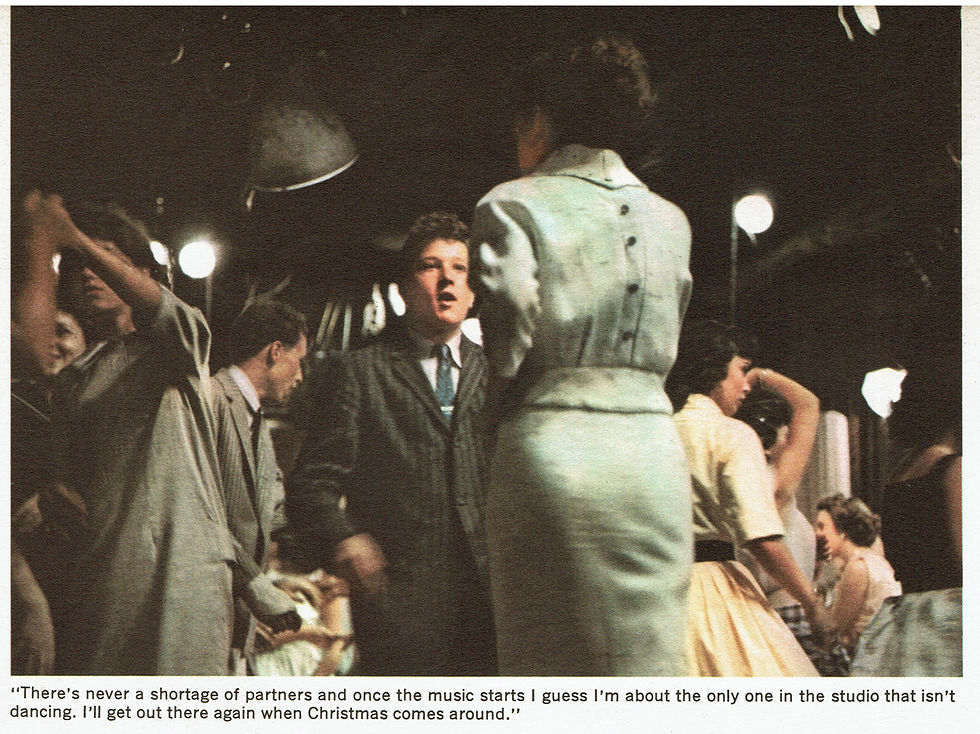
Ever heard of a dance called "The Slop?" (Can you even imagine asking someone, “Want to slop together?”) Does "The Walk" sound like something that you wouldn’t mind doing off on the side of the dance floor, by yourself, if you’ve just been turned down by the girl you thought was smiling at you, and you still want to continue “looking cool”...as your chuckling buddies look on? Want to impress fellow guests with your vintage knowledge at the next tiki pool party by casually mentioning that you’ve just mastered “The Slauson Shuffle”, “The Flea”, “The Dishrag Spin”, and most importantly, “The Itch”, while they look on with admiration...or blank stares?
When most folks think of 1950’s Rock n’ Roll Era dance styles, three things often come to mind.
If the individual is a part of the current Rockabilly Scene, then that person’s dance mindset, to shamelessly quote several blogs, would be “Jiving, Strolling, and Bopping.” If the person is “mainstream”, he or she might think (quite understandably because of the movies) swing dancing, albeit done to Rock n’ Roll music. (Or somewhat mistakenly, “The Twist”, which historically didn’t actually hit the mainstream until 1960, the though song and dance itself was done in African-American teen communities as early as late 1958. being the b-side of Hank Ballard's "Teardrops On Your Letter.") And for those few swing dancers who have been slowly invading “Viva Las Vegas” and Hawk Valentine’s “Hop” (well, I admit, my dance partner and I are two of them), it would be specifically Smooth Style Lindy Hop, because that’s what professional dancers did in all of those made-in-the 1950’s b-movies. (“Professionals,” meaning 30-somethings who were left over performers from Big Band Era “Andy Hardy” movies and who were then playing “teenagers” in Rocksploitation and Teensploitation/Juvenile Delinquent drive-in flicks.)
But what did real teenagers do in the 1950’s?

Rock n’ Roll music, and the youth culture that encouraged its growth, has been a lifetime obsession for many fans of all ages (including the young) in the "vintage lifestyle community." (For me, ever since I saw the ABC TV Special “The Heroes of Rock n’ Roll” with my mom way back in 1979 hosted by Beau Bridges, I was instantly hooked and the documentary is up on You Tube.)

For many fans of 1950s culture, dancing "like the 1950s" often means taking formal lessons, whether that means the "jiving, strolling, and bopping" of "rockabilly weekenders" like Viva Las Vegas or the Nashville Boogie, or (if we are talking about emulating 1950s movies) lessons in the Los Angeles versions of lindy (or lindy hop, though apparently, the "hop" part of the phrase is removed from LA vernacular), with "retro" iterations, such as "Dean Collins" lindy or "Hollywood style" lindy (a phrase trademarked by Erik Robeson and Sylvia Skylar, and I hope I don't get sued for mentioning it here!)

Above and below are examples of the type of "1950s movie dancing" that is being referred to, in actuality, repurposed Big Band-era lindy, done to 1950s rock n' roll music on film.

However, if one were to talk to senior citizens of a specific age range, one would get a more "realistic" idea of how they actually danced when they were teenagers.
What American teens of the 1950s actually did when dancing at record hops was actually quite different from both the “Jiving, Strolling, and Bopping” as done by most of the Rockabilly community, as well as the “Smooth Style Lindy Hop, Balboa, and Collegiate Shag” of the (invading) swing dancers in the "rockabilly scene." (Yeah, there sometimes can be, disagreements, as to how 1950s dances "should" be done in the current vintage scene, a discussion worthy of a different blog altogether.)

Listing down every single dance style variation from the 1950’s would be impossible in a blog, and is better suited for a book (there are several, including the excellent “Rock n’ Roll Dances of The 1950’s" by Lisa Jo Sagolla.) But there are a few main ones that I can list and briefly describe here. The information is culled from research and interviews, particularly with the late Manny Interiano, Lois Dallal, and a few other members of “The Regulars” from the “KPIX Dance Party” (a local SF Bay Area after-school tv dance show in the “American Bandstand” vein that first aired in 1959), as well as interviews with senior citizens of appropriate age. (I teach seniors fitness for a living, so fortunately, I have access to individuals who would have grown up during that era.) * Personal note. I only gleaned information from those who I “tested” by asking them questions about rock n’ roll music. If they "knew their stuff," I knew that they were a part of "that scene" back then. However, if they liked Perry Como, Lawrence Welk, or Mitch Miller (yikes!), and couldn’t understand why a fondness for that type of music is incompatible with a love of rock n’ roll music, then I had to disregard their "recollecitons." If they had no idea who Gene Vincent was unless I had to mention “Be Bop A Lula”, then I knew to never talk about music to them ever again, though of course, I would politely and compassionately listen to their questions regarding their various chronic aches and pains. (It comes with the job of teaching seniors fitness.) Below is a short list of some of the dance styles that (as far as I know), have still not quite made it onto today’s "rockabilly scene" dance floor.

The Cha-Lypso:
It’s supposedly a combination of the Cha-Cha and the Calypso dances. (Calypso, as in Harry Belafonte’s “Banana Boat Day-O” song.) However, after taking Cha Cha lessons and simplifying it (and even taking out the hip motion!), I danced with some of the seniors and they said, “You know how to Cha-Lypso!” So apparently, in actual practice, it’s a simplified (or dumbed down?) Cha Cha. It’s best when danced to Billy and Lillie’s “La Dee Dah.” It can also be done to just about any doo-wop song with a latin rhythm, as well as country rocker Johnny Horton’s “Lover’s Rock.” The Strand: According to the sources I’ve read, The Strand was a “graceful, spinning dance.” American Bandstand regulars Jimmy Peatross and Joan Buck introduced this style on an episode of that famous (or infamous?) after-school tv dance show. I’m also guessing (just guessing, mind you) that it is indeed The Strand that they are doing to Johnnie and Joe’s “Over The Mountain, Across The Sea” in the documentary “Twist!” from the 1990’s. (Though I can’t understand why he dips her with his back to the camera!) Anyway, if I’m correct, it’s basically a smoother version of jitterbug swing dancing, it can be danced to slow music (but not necessarily limited to slow songs) and if some online sites are to be believed (well shouldn’t we all?) it’s a precursor to The Carolina Shag dance style (you know, the dancing done in that other 1980’s movie with Phoebe Cates, the one where she doesn’t strip topless while emerging from a swimming pool in a dream sequence!) On the subject of those American Bandstand regulars, they claimed that they were beaten up by some African-American teen acquaintances of theirs over the subject of The Strand. It seems that Peatross and Buck took on-air credit for “making up the dance” while not mentioning that they had in fact, learned The Strand from their (African-American) neighbors. In all fairness to them, they did come clean in that “Twist” documentary. Segregation was very real in the 1950’s, even if it wasn’t officially legal in most areas north of The Mason-Dixon Line. Unofficial social segregation was often the norm back then. Bandstand regulars Joan Buck and Jimmy Peatross admitted in an interview for Ron Mann's "Twist!" documentary that they pretty much learned most of their dances from their African-American classmates, but they couldn’t openly give credit on the air to them (or at least, they said that they felt they couldn’t.)
The Walk: As I know most of you know, Jimmy McCracklin cut a hit song about this one (to be found on Volume 5 on Ace’s “The Golden Age of American Rock n’ Roll”, which is probably where many of us have it.) The Walk was kind of an intentionally “sloppy” dance style (but that’s what made it fun!) Think a modified Conga Line, but done to bluesy, rockin’ music. Hold each other’s waist and throw out the same side arm and leg and throw out your midsection! If you haven’t suffered a slipped disc(!), then return your feet to starting position and redo that “throwing out motion” with the arm and leg on the other side (and if you can actually reproduce this dance by just reading this, you’re a better dancer than I am!)
The Slop:
Guys, put your hands in your pockets, pull up your pants, show your socks, and swivel your feet in time with the beat, while doing a corkskrew motion with said feet. Dip a shoulder from time to time, too. That’s The Slop! Gals can do it too and it’s a non-partnered, improvised dance. (So Rockabilly friends, think about adding this to your “Boppin’.”) The Circle Dance:
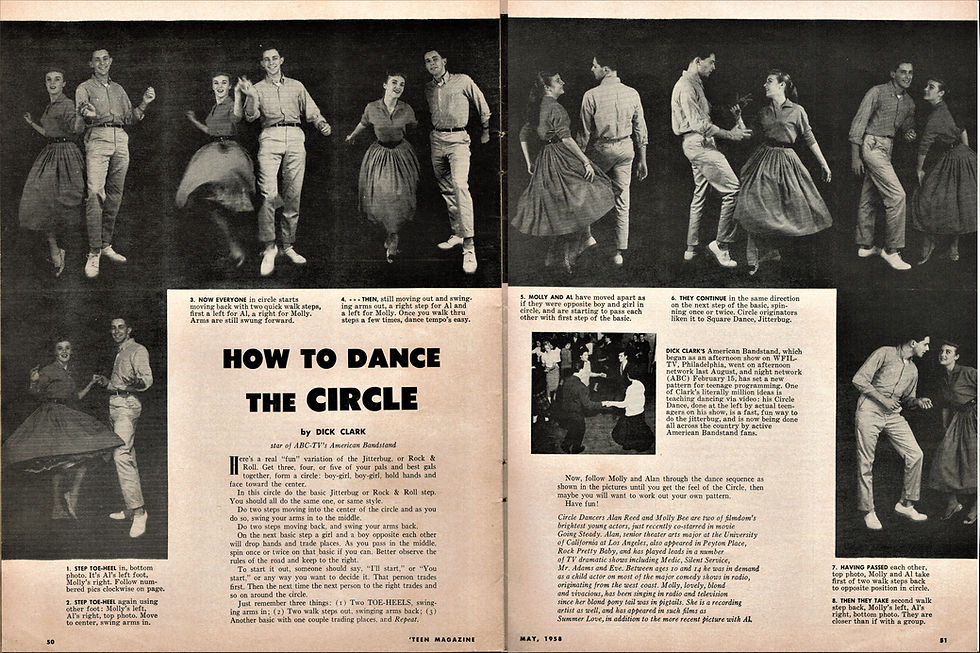
The circle dance is easy to describe and reproduce. Basically, it's swing dancing combined with square dancing (?!), adapted to rock n’ roll. You and a group basically form a circle and each couple pushes off each other and turns themselves while one lady goes around the outside of the circle touching everyone’s hands held low in the back while doing so (the hands, from behind, close to the behind. Don’t miss!) After she’s done, the next lady goes, etc. One of the few American Bandstand dances that was original to the show’s regulars and not taught by African-American classmates in Philadelphia to said regulars or inspired by dances done on the Wilmington, Delaware local African-American TV record hop show "The Mitch Thomas Show"...and it shows. (It's a bit "square," but it does look fun if you're short of couples and a group of friends would like to dance together.)

The Chicken: Well, like the names “Shag”, “Bop”, and “Jitterbug”, The Chicken is actually the name of several completely different dances. According to Manny Interiano of the “KPIX Dance Party”, it was basically a swing dance/cha cha variation. But there’s another (in my biased opinion, sillier) dance also called “The Chicken”, who’s name is pretty descriptive (well, if you do it “correctly”, you might end up in a Family Special Bucket at The Colonel’s!) Doing a swing/cha cha variant appeals to me personally. Kicking up my feet, bobbing my head, scratching my feet on the floor...doesn’t. (Though I understand that there are “underground subcultures” in San Francisco that like this sort of thing, between two consenting adults.)

The Stroll, The Bop, and The Madison: I address these because, as we all know, Boppin’ and Strollin’ are a part of the current scene. We already know that The Stroll done today is a line dance done by the ladies while The Stroll of the 1950’s involved two lines, girls on one side, boys on the other, with couples doing basically a “Camel Walk” down the center while holding hands. (Camel Walking involves stepping, then stepping behind that first leg with the other, then bending at the knees with one knee behind the other.)

The Bopping done in today’s rockabilly scene often (but not always) has a “down up, down up” motion with a step and bend at the knees. My Facebook friend Kim Smallwood wrote in her blog from 2010 that it “sometimes looks like retarded ‘80’s dancing!” (I’m sure she meant that with affection.)
However, The Bop of the 1950’s, that is the solo Bop of this blog, involves a toe-heel step with alternating feet, with one foot on the toe and the other on the heel, both twisting in opposite directions, while bending at the knees. It can be seen in the 1958 movie “Hot Rod Gang” with Kay “Rock, Baby, Rock It!” Wheeler performing it with the grace and bravado of today’s hip hop dancers, to John Ashley’s rocker “Hit And Run Lover.” There is also another dance called “The Bop” which was (surprise!) a partnered jitterbug/swing dance variation.

The Madison, the called out line dance showcasing moves named after several then-current pop-culture references and featured in the original 1989 movie version of “Hairspray”, is sometimes done today in (strangely enough) the swing dance scene. I’ve only seen it done once at a rockabilly show in San Jose a few years back. Rockin’ Raul Castro (winner of several Viva Las Vegas Jiving contests) started it when dee-jay Tanoa “Samoa Boy” Stewart played it. Raul then grabbed me because he knew I knew it and we both led the crowd behind us! That’s the only time I’ve ever seen it at a rockabilly show and I can honestly say that I was a part of that one time occurrence.
There are many other 1950’s dance styles that could be described (but this blog is already too long) and if one were to count the various fad dances of the early 1960’s that came (and went!) in the wake of Chubby Checker’s cover of Hank Ballard’s “The Twist”, then I could be typing this thing all week! On that subject, I will mention in passing both The Mashed Potatoes and The Bristol Stomp. Both have their origins in the old Charleston dances and the “Charleston” that (Savoy Style) Lindy Hoppers do side by side, is almost identical to The Bristol Stomp. Don’t touch each other, and make your (Savoy Lindy) Charleston smaller, and you’re doing The Bristol Stomp. I asked one of the seniors in my class to demonstrate it and when I remarked, “That’s a Charleston!” she said, “Really? Well, this is how you do The Bristol Stomp!” The Mashed Potatoes does occasionally rear itself today at ‘60’s retro shows (which I’ve seen some rockabilly folks attend) and if you have enough coordination to twist out your heels while staying on the balls of your feet, to the beat, it’s reasonable difficulty does make the person doing it look pretty cool, in my opinion.
Keep in mind that there were many local variations of the dance styles listed above. For instance, a person who did “The Strand” in Philadelphia did it differently from New York. My senior fitness participants (the ones who were into Rock n’ Roll in the 1950’s and early 1960’s, that is) told me that they even knew what school a kid came from by the way that kid would dance, whether it was a style or a variation of a certain dance style. As a general rule, almost all of these dances (with the exception of The Circle Dance) came from an African-American influence or origin. It's the old stereotype of "black kids teaching the white kids how to dance." While I just admitted that sounds stereotypical (and "politically incorrect"), in the case of the 1950's Rock N' Roll Era, it certainly was true, at least with most examples. An interesting side note is the fact that because many of the solo, non-partnered dances listed here are based on jazz steps, and because much of modern day hip hop street dancing is also based on jazz steps, (again, both stemming from an African-American origin) there are some modern day hip hop moves that are practically identical to the individual solo non-partnered dance steps of the 1950’s. (For example, I’ve personally seen a move in a hip hop dance class that was virtually the same as the 1950’s version of The Bop.)


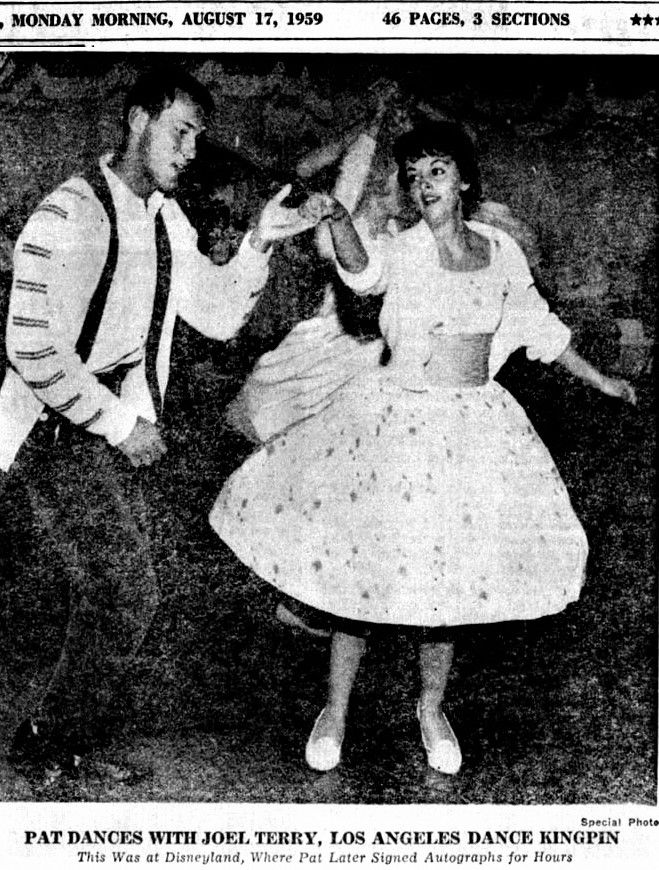
Swing dance variations, referred to as “Jitterbug” (hey, a Big Band Era term!) were also extremely common place, with both the “KPIX Dance Party Regulars” that I interviewed, as well as the seniors in my classes of appropriate age/generation, using that term. (This information, obtained from individuals who actually participated in that scene during that time, runs counter to some “official” histories told in both the rockabilly and the swing dance/lindy hop communities. I have to note that the information obtained was consistent, voiced by individuals who often did not know each other personally, who came from different parts of the country, and who have absolutely no agenda in the way of promoting or selling classes or events.)

Finally, most of the dances, even those based on either swing or cha-cha, were simplified, making them look different from their formalized, instructional predecessors and “easy to do” when compared to the flashy, partnered acrobatics that we see in the movies.
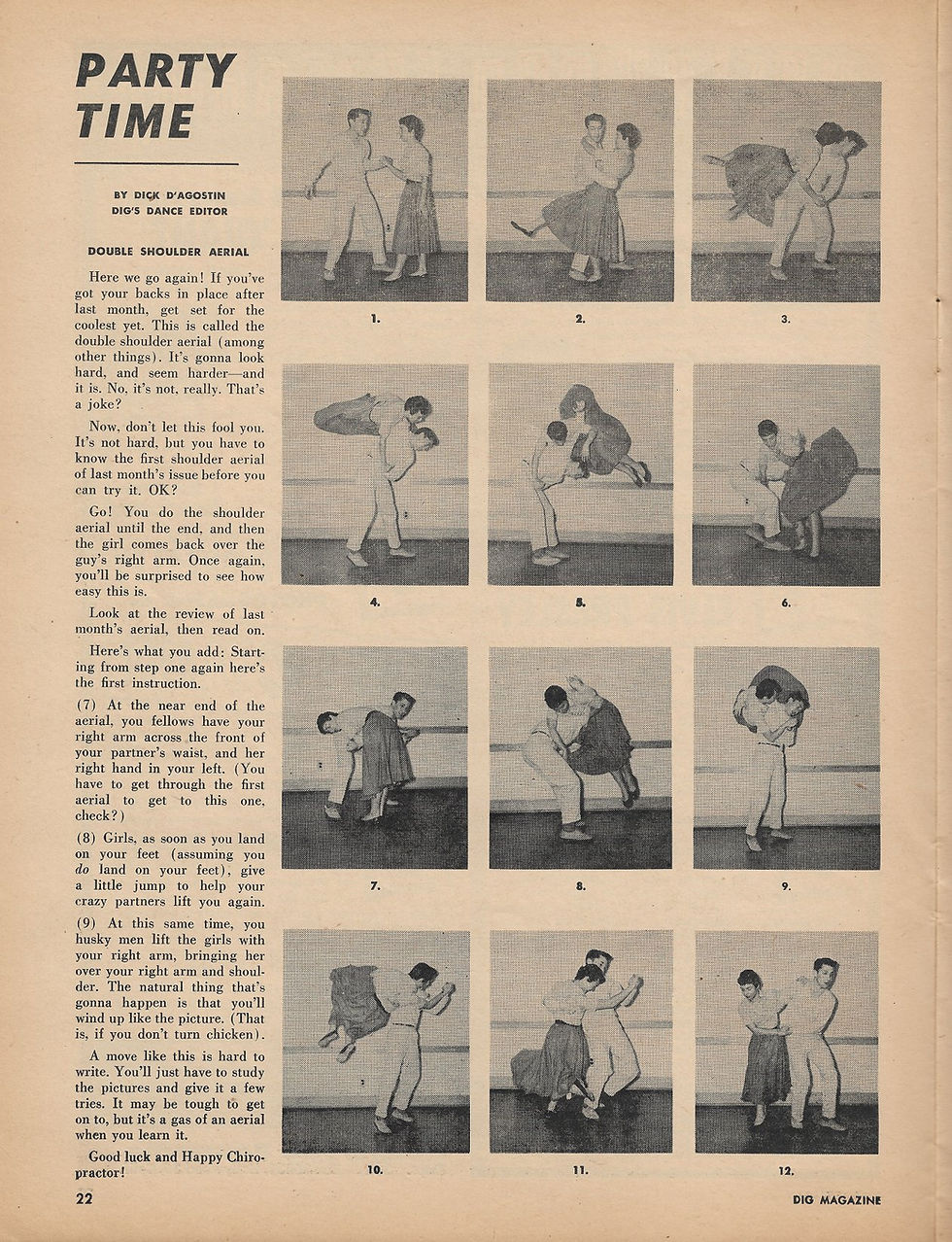
From a personal standpoint, I still love attending Jiving workshops. I still love teaching Smooth Style Lindy Hop with my dance partner (we’re both show offs and we never step on other people’s feet!) The Jiving, Strolling, Bopping and the Smooth Lindy, Bal, and Shag should still be a part of the current "vintage" scene.
Personally, I think that it would be fun for many of us to hold and attend workshops featuring these lost 1950’s dance styles. After all, the vintage lifestyle scene has shown a very diverse selection of ‘50’s music and ‘50’s clothing. If we truly love the aesthetic of that time period’s youth culture, then why not make room for these other lost teen dance styles of the 1950’s and early ‘60’s?


For further reading on the subject of teen dancing on after-school tv shows, I highly recommend visiting this site: http://www.kpixdanceparty.org/index.html


Comments